


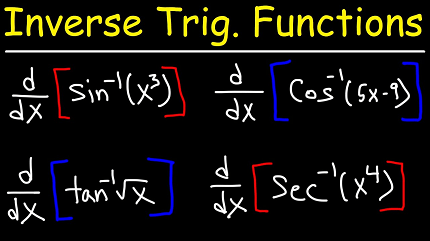

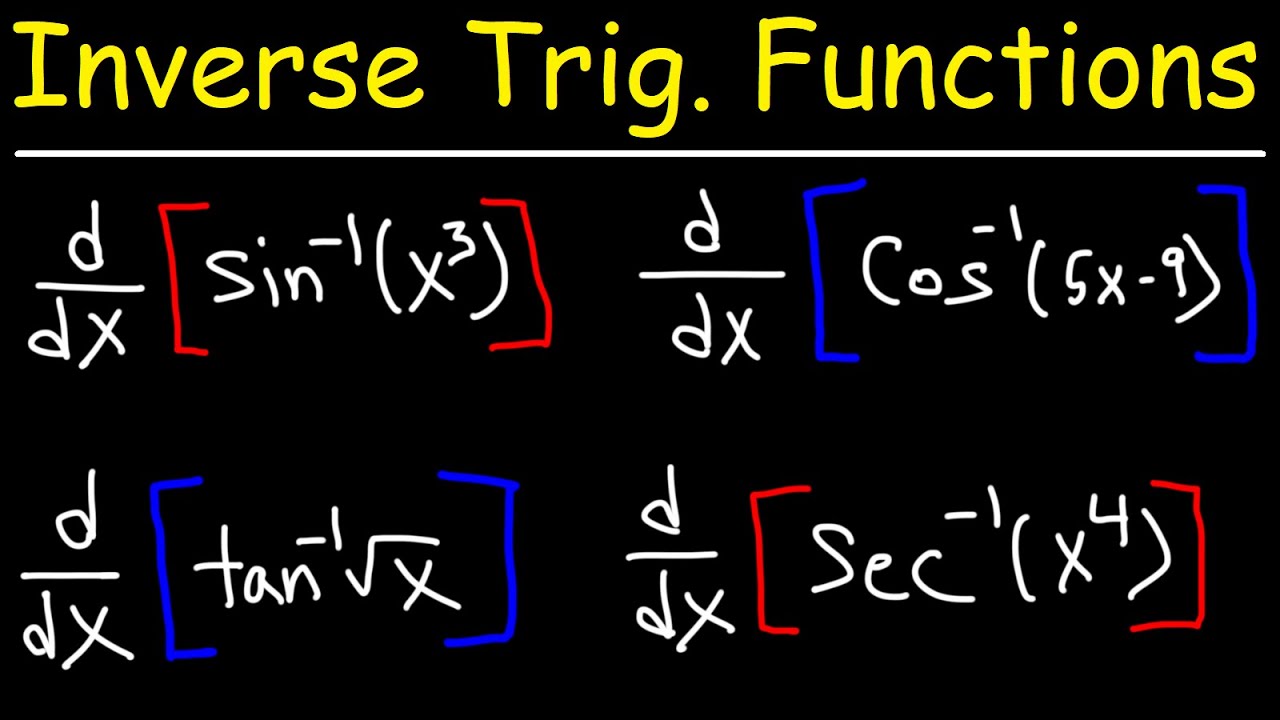
The inverse trigonometric functions are a set of functions that allow us to find the angle or angles associated with a given trigonometric ratio (sine, cosine, tangent, etc.). They are denoted by the prefix “arc” or “inverse” and the abbreviation of the trigonometric function, for example:
- Arcsine (arcsin or sin^-1): returns the angle whose sine is a given number.
- Arccosine (arccos or cos^-1): returns the angle whose cosine is a given number.
- Arctangent (arctan or tan^-1): returns the angle whose tangent is a given number.
- Arccotangent (arccot or cot^-1): returns the angle whose cotangent is a given number.
- Arcsecant (arcsec or sec^-1): returns the angle whose secant is a given number.
- Arccosecant (arccsc or csc^-1): returns the angle whose cosecant is a given number.
For example, if we want to find the angle whose sine is 0.5, we can use the arcsine function:
arcsin(0.5) = sin^-1(0.5) ≈ 30°
This means that the sine of 30 degrees is equal to 0.5. Similarly, we can use the other inverse trigonometric functions to find angles associated with other trigonometric ratios.
What is Required Inverse trigonometric
In differential calculus, the derivatives of the inverse trigonometric functions play an important role. The derivatives of the inverse trigonometric functions are as follows:
- The derivative of arcsin(x) with respect to x is 1/√(1-x^2).
- The derivative of arccos(x) with respect to x is -1/√(1-x^2).
- The derivative of arctan(x) with respect to x is 1/(1+x^2).
- The derivative of arccot(x) with respect to x is -1/(1+x^2).
- The derivative of arcsec(x) with respect to x is 1/(|x|√(x^2-1)).
- The derivative of arccsc(x) with respect to x is -1/(|x|√(x^2-1)).
These formulas can be used to find the derivatives of more complicated functions that involve inverse trigonometric functions. For example, if we have a function of the form f(x) = arctan(x^2), we can use the chain rule to find its derivative:
f'(x) = d/dx [arctan(x^2)] = 1/(1+(x^2)^2) * d/dx [x^2] = 2x/(1+x^4)
Similarly, we can use the derivative formulas to find the derivatives of other functions that involve inverse trigonometric functions.
Who is Required Inverse trigonometric
The knowledge of differential calculus and inverse trigonometric functions is typically required for students studying mathematics, physics, engineering, and other related fields at the undergraduate or advanced high school level.
In mathematics, the study of calculus involves the analysis of functions and their rates of change, which includes the differentiation of functions using techniques such as the chain rule and product rule. Inverse trigonometric functions are a special class of functions that often appear in calculus problems, and knowledge of their derivatives is essential for solving problems involving these functions.
In physics, calculus and inverse trigonometric functions are used to model and analyze physical phenomena such as motion, forces, and waves. In engineering, calculus and inverse trigonometric functions are used in fields such as control theory, signal processing, and electrical engineering.
Overall, knowledge of differential calculus and inverse trigonometric functions is essential for many areas of science, technology, and mathematics.
When is Required Inverse trigonometric
Differential calculus and inverse trigonometric functions are typically required when studying more advanced mathematical concepts or when solving problems that involve these functions. Some examples of when differential calculus and inverse trigonometric functions may be required include:
- Calculus courses: Differential calculus and inverse trigonometric functions are typically covered in introductory calculus courses, which are often required for students studying mathematics, science, engineering, or economics.
- Solving trigonometric equations: Sometimes, inverse trigonometric functions are used to solve equations involving trigonometric functions. For example, if we need to solve the equation sin(x) = 0.5, we can use the arcsin function to find the value of x that satisfies this equation.
- Optimization problems: Optimization problems involve finding the maximum or minimum values of a function. Inverse trigonometric functions can be used in these problems, especially when dealing with angles or ratios involving angles.
- Physics problems: Calculus and inverse trigonometric functions are often used to model and analyze physical phenomena such as motion, forces, and waves.
- Engineering problems: Inverse trigonometric functions are often used in engineering fields such as control theory, signal processing, and electrical engineering.
Overall, differential calculus and inverse trigonometric functions are required when studying advanced mathematical concepts or when solving problems that involve these functions in various fields of study.
Where is Required Inverse trigonometric
The knowledge of differential calculus and inverse trigonometric functions is required in various fields of study, including:
- Mathematics: Differential calculus and inverse trigonometric functions are fundamental concepts in calculus courses, which are typically required for students studying mathematics, science, engineering, or economics.
- Physics: Calculus and inverse trigonometric functions are used to model and analyze physical phenomena such as motion, forces, and waves in physics.
- Engineering: Inverse trigonometric functions are used in engineering fields such as control theory, signal processing, and electrical engineering.
- Computer science: Calculus and inverse trigonometric functions are used in computer graphics and computer vision, among other areas.
- Economics: Calculus and inverse trigonometric functions are used in economics to model and analyze various economic phenomena.
- Statistics: Inverse trigonometric functions are used in statistics, particularly in the analysis of circular data.
Overall, differential calculus and inverse trigonometric functions are required in many fields of study where mathematical concepts and problem-solving skills are necessary.
How is Required Inverse trigonometric
Differential calculus and inverse trigonometric functions are typically studied and applied in the following ways:
- Understanding the concepts: To understand differential calculus and inverse trigonometric functions, one needs to learn the definitions and properties of these functions. This includes learning the concepts of limits, derivatives, and integrals, as well as the inverse trigonometric functions and their derivatives.
- Solving problems: To apply differential calculus and inverse trigonometric functions, one needs to learn how to solve problems that involve these concepts. This includes solving optimization problems, finding the maximum and minimum values of a function, and finding solutions to equations involving inverse trigonometric functions.
- Calculus techniques: To apply differential calculus, one needs to learn the various techniques of differentiation and integration, such as the product rule, quotient rule, and chain rule. These techniques are essential for solving more complex problems.
- Applications in various fields: Differential calculus and inverse trigonometric functions have numerous applications in various fields such as physics, engineering, computer science, economics, and statistics. Therefore, understanding the concepts and techniques of calculus is essential for solving problems and making predictions in these fields.
Overall, understanding and applying differential calculus and inverse trigonometric functions involves a combination of learning the concepts, techniques, and applications of these functions. This requires a solid understanding of mathematics and problem-solving skills.
Case Study on Inverse trigonometric
Here is an example case study that demonstrates the application of differential calculus and inverse trigonometric functions:
Case Study: Maximizing a Trigonometric Function
A company produces cylindrical containers with a fixed volume of 100 cubic meters. The company wants to minimize the amount of material used in manufacturing these containers while maintaining the volume constant. The containers have a circular base and a height of 5 meters. The material cost is proportional to the surface area of the container.
The surface area of a cylinder is given by the formula:
SA = 2πr^2 + 2πrh
where r is the radius of the cylinder and h is its height.
The volume of the cylinder is given by the formula:
V = πr^2h
We need to find the dimensions of the cylinder that minimize the surface area, which will, in turn, minimize the material cost.
Solution:
Let’s start by using the volume formula to solve for the height of the cylinder in terms of its radius:
h = 100/πr^2
Substitute this expression for h into the surface area formula to get:
SA = 2πr^2 + 2πr(100/πr^2)
Simplifying this expression, we get:
SA = 2πr^2 + 200/r
To find the minimum surface area, we need to find the value of r that minimizes the surface area function. We can use differential calculus to do this.
To find the critical points, we need to find where the derivative of the surface area function is equal to zero:
dSA/dr = 4πr – 200/r^2 = 0
Solving for r, we get r = 5√10.
To verify that this value of r corresponds to a minimum surface area, we need to take the second derivative of the surface area function:
d^2SA/dr^2 = 4π + 400/r^3
At r = 5√10, the second derivative is positive, indicating that this is a minimum value.
Therefore, the minimum surface area is achieved when the radius of the cylinder is 5√10 meters and the height is 100/π(5√10)^2 meters.
This solution minimizes the material cost of manufacturing the containers while maintaining a constant volume of 100 cubic meters.
White paper on Inverse trigonometric
Here is a white paper that provides an overview of differential calculus and inverse trigonometric functions:
Introduction
Differential calculus is a branch of mathematics that deals with the study of rates of change and slopes of curves. It is a fundamental concept in calculus and is used in various fields such as physics, engineering, computer science, economics, and statistics. One important class of functions in differential calculus is the inverse trigonometric functions, which are used to solve problems involving angles and trigonometric ratios.
This white paper provides an overview of differential calculus and inverse trigonometric functions, including their definitions, properties, and applications.
Differential Calculus
Differential calculus is concerned with the study of rates of change and slopes of curves. It involves the concept of derivatives, which are measures of the instantaneous rate of change of a function at a given point. The derivative of a function f(x) is denoted by f'(x) or df/dx and is defined as the limit of the difference quotient:
f'(x) = lim (f(x + h) – f(x))/h as h approaches 0.
The derivative of a function f(x) represents the slope of the tangent line to the graph of f(x) at the point (x, f(x)). The derivative is used to solve problems involving optimization, such as finding the maximum and minimum values of a function, and to analyze the behavior of functions near critical points.
Inverse Trigonometric Functions
The inverse trigonometric functions are a group of functions that are used to solve problems involving angles and trigonometric ratios. There are six inverse trigonometric functions, including the inverse sine (arcsin), inverse cosine (arccos), inverse tangent (arctan), inverse cotangent (arccot), inverse secant (arcsec), and inverse cosecant (arccsc).
The inverse sine function is defined as the inverse of the sine function. It is denoted by arcsin(x) or sin^-1(x) and is defined as the angle whose sine is x:
arcsin(x) = y if sin(y) = x and -π/2 <= y <= π/2.
Similarly, the other inverse trigonometric functions are defined in terms of their respective trigonometric functions.
Applications
Differential calculus and inverse trigonometric functions have numerous applications in various fields of study. Some common applications include:
- Physics: Differential calculus is used to model and analyze physical phenomena such as motion, forces, and waves in physics. Inverse trigonometric functions are used to solve problems involving angles and trigonometric ratios.
- Engineering: Differential calculus and inverse trigonometric functions are used in engineering fields such as control theory, signal processing, and electrical engineering.
- Computer Science: Differential calculus and inverse trigonometric functions are used in computer graphics and computer vision, among other areas.
- Economics: Differential calculus and inverse trigonometric functions are used in economics to model and analyze various economic phenomena.
- Statistics: Inverse trigonometric functions are used in statistics, particularly in the analysis of circular data.
Conclusion
Differential calculus and inverse trigonometric functions are fundamental concepts in mathematics and have numerous applications in various fields of study. Differential calculus involves the study of rates of change and slopes of curves, while inverse trigonometric functions are used to solve problems involving angles and trigonometric ratios. Understanding and applying these concepts requires a solid understanding of mathematics and problem-solving skills.