Vrindawan Coaching Center

Preparation

The d-block elements, also known as transition metals, can be prepared through several methods depending on the specific element and its properties. Here are some general methods: It’s worth noting that these methods are not exhaustive and that there may be other methods specific to certain d-block elements. What is Required d-Block Elements Preparation The…
Catalytic properties

Catalytic properties refer to the ability of a substance or material, called a catalyst, to increase the rate of a chemical reaction without being consumed or undergoing any permanent chemical changes itself. A catalyst works by lowering the activation energy required for a reaction to occur, thereby increasing the speed at which the reaction takes…

Interstitial compounds

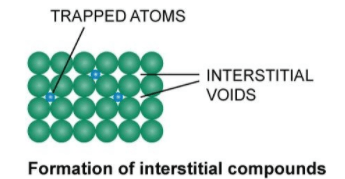
Interstitial compounds are compounds that are formed by inserting atoms or smaller molecules into the interstices or voids of a host crystal lattice. These compounds are usually formed by chemically reacting the host lattice with an appropriate guest molecule or atom. One example of an interstitial compound is interstitial solid solutions, which are formed when…

Group 17 Bleaching powder

Group 17 in the periodic table includes the elements fluorine (F), chlorine (Cl), bromine (Br), iodine (I), and astatine (At). Bleaching powder, also known as calcium hypochlorite (Ca(ClO)2), is a compound that contains both calcium and chlorine. Bleaching powder is often used as a disinfectant and bleaching agent for textiles, paper pulp, and hair. When…

Group 17 Hydrogen chloride and Interhalogen compounds

Group 17, also known as the halogens, includes elements such as fluorine, chlorine, bromine, iodine, and astatine. Hydrogen chloride is a compound composed of hydrogen and chlorine, while interhalogen compounds are compounds composed of two different halogens. Hydrogen chloride (HCl) is a colorless gas that dissolves readily in water to form hydrochloric acid. It is…

Group 17 Properties

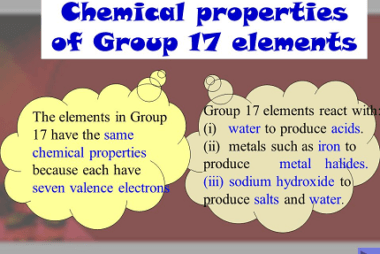
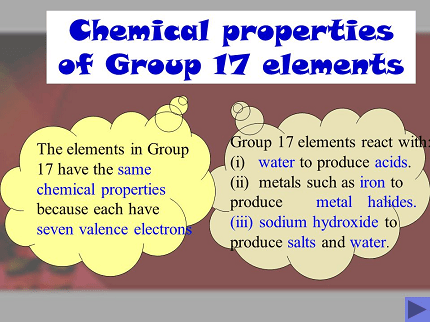
Group 17 of the periodic table, also known as the halogens, consists of the elements fluorine (F), chlorine (Cl), bromine (Br), iodine (I), and astatine (At). Here are some of their general properties: Overall, the halogens are a highly reactive group of elements with a variety of chemical properties. What is Required p-Block Elements Group…

Group 17 Oxygen and Metals

Group 17 of the periodic table is known as the halogens, and includes elements such as fluorine, chlorine, bromine, iodine, and astatine. Oxygen, on the other hand, is in Group 16, also known as the chalcogens. Oxygen is a nonmetal, whereas the halogens are all nonmetals except for astatine, which is a metalloid. These elements…

Group 17 Reactivity towards hydrogen

Group 17 of the periodic table, also known as the halogens, includes elements such as fluorine (F), chlorine (Cl), bromine (Br), iodine (I), and astatine (At). The reactivity of these elements towards hydrogen depends on a few factors, including their electronegativity, atomic size, and their ability to form hydrogen bonds. Fluorine, being the most electronegative…

Group 16 Oxoacids of sulfur

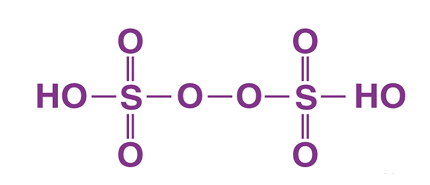
Sulfur forms a variety of oxoacids, which are acids that contain oxygen and sulfur. There are several oxoacids of sulfur, but the most common ones are the Group 16 oxoacids of sulfur, which include sulfuric acid, sulfurous acid, thiosulfuric acid, and dithionic acid. All of these oxoacids of sulfur have important industrial and commercial applications,…

Group 16 Sulfur dioxide

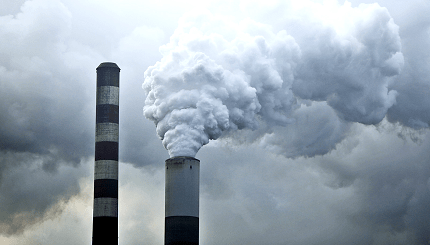
Sulfur dioxide (SO2) is a colorless gas with a pungent odor that is formed by burning sulfur-containing fuels, such as coal and oil, and from volcanic activity. It is a major air pollutant, and exposure to high levels of SO2 can have harmful effects on human health, including respiratory problems and irritation of the eyes,…