Vrindawan Coaching Center

Van der Waals equation

The van der Waals equation is an equation of state that describes the behavior of real gases, taking into account the non-ideal behavior of gases due to intermolecular forces. It was proposed by Johannes Diderik van der Waals in 1873. The equation is given by: (P + a(n/V)^2)(V – nb) = nRT where P is…
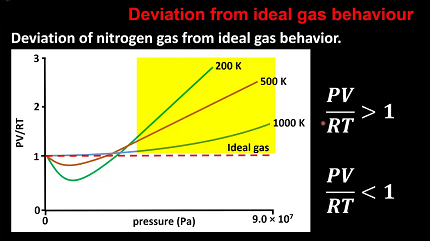
Deviation from ideality

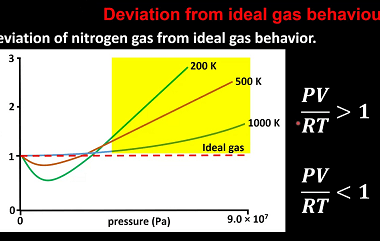
In many fields, including physics, chemistry, and engineering, the concept of an ideal situation or system is often used as a theoretical or idealized benchmark for comparison with real-world situations. However, in practice, it is rare to encounter a situation that perfectly conforms to the ideal model. When a system deviates from the ideal model,…

Absolute scale of temperature

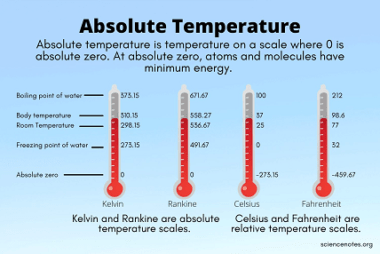
The absolute scale of temperature is a temperature scale that starts at absolute zero, the theoretical lowest possible temperature where all matter would have zero thermal energy. The most commonly used absolute temperature scale is the Kelvin (K) scale, which is defined such that 0 K is equal to -273.15°C, the temperature at which all…

Gas laws and ideal gas equation

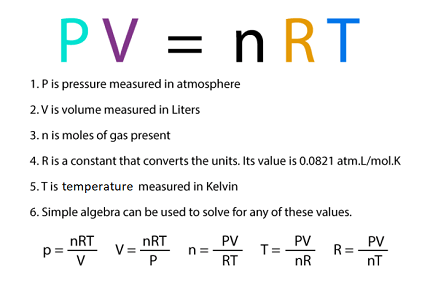
Gas laws describe the behavior of gases under different conditions, such as temperature, pressure, and volume. There are several gas laws, including Boyle’s law, Charles’s law, Gay-Lussac’s law, and the combined gas law, that relate these variables to one another. Boyle’s law states that at constant temperature, the volume of a gas is inversely proportional…

Molality and Normality

Molality and Normality are both measures of concentration used in chemistry. Molality (symbol: m) is defined as the number of moles of solute per kilogram of solvent. It is expressed in units of moles per kilogram (mol/kg). Molality is a useful measure of concentration when temperature changes occur because it is not dependent on temperature,…

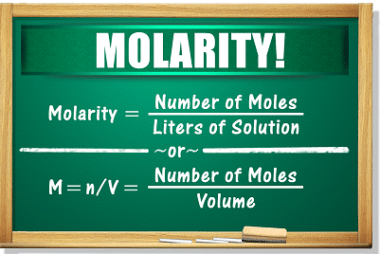
Molarity

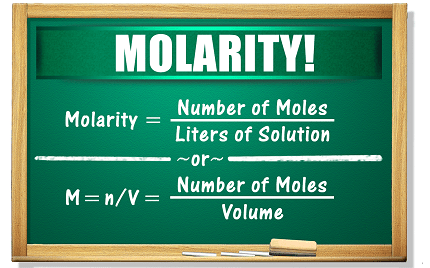
Molarity is a unit of concentration used in chemistry, which measures the number of moles of a solute per liter of a solution. The symbol for molarity is M, and it is expressed in units of mol/L or M. For example, a 1 M solution of hydrochloric acid (HCl) contains 1 mole of HCl per…

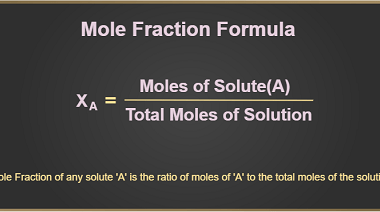
Concentration in terms of mole fraction

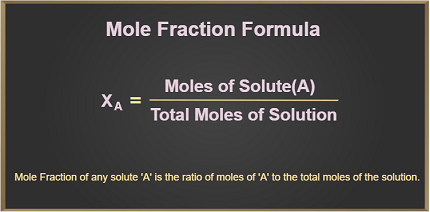
Concentration can be expressed in terms of mole fraction, which is defined as the ratio of the number of moles of a particular substance to the total number of moles in the mixture. The mole fraction of a substance A in a mixture of n substances can be calculated using the following formula: Mole fraction…

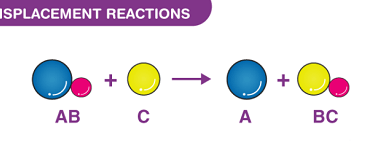
Displacement reactions

A displacement reaction, also known as a replacement reaction, is a chemical reaction in which an atom or ion from one compound is replaced by an atom or ion of another compound. These reactions typically occur between a metal and a solution of a metal salt, or between a nonmetal and a solution of a…

Neutralisation

Neutralization is a chemical reaction between an acid and a base, resulting in the formation of a salt and water. During this reaction, the hydrogen ions (H+) from the acid react with the hydroxide ions (OH-) from the base to form water, and the remaining ions combine to form a salt. The general chemical equation…

Calculations (Based on mole concept and Stoichiometry) involving common oxidation-reduction

Oxidation-reduction (redox) reactions involve the transfer of electrons between reactants. The mole concept and stoichiometry can be used to calculate the quantities of reactants and products involved in redox reactions. Here are some common calculations based on mole concept and stoichiometry involving redox reactions: 5Fe2+ + MnO4- + 8H+ → 5Fe3+ + Mn2+ + 4H2O…