Vrindawan Coaching Center

Wave function and Probability density (plots only)

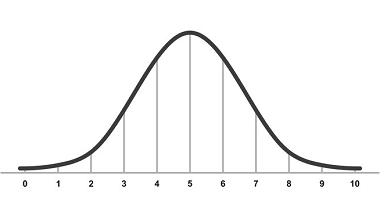
Wave function In quantum material science, a wave capability is a numerical depiction of the quantum condition of a secluded quantum framework. The wave capability is a complex-esteemed likelihood plentifulness, and the probabilities for the potential consequences of estimations made on the framework can be gotten from it. The most widely recognized images for a…
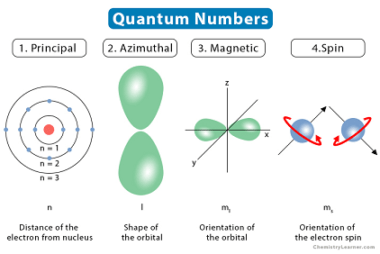
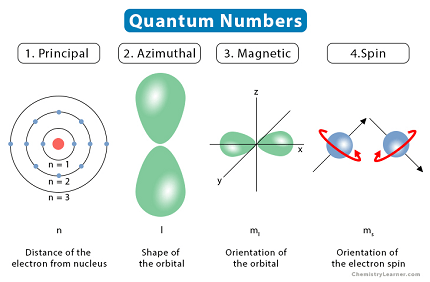
Quantum numbers

Quantum numbers are a set of numbers that describe the state of an electron in an atom or molecule. There are four quantum numbers: Together, these four quantum numbers provide a unique set of parameters that describe the state of an electron in an atom or molecule. What is Required Quantum numbers In quantum mechanics,…

Energies

Energy is a fundamental concept in physics, and it refers to the ability of a system to do work. There are various forms of energy, including: These different forms of energy can be converted from one form to another, and the total amount of energy in a closed system is conserved, meaning it cannot be…

Qualitative quantum mechanical picture of hydrogen atom

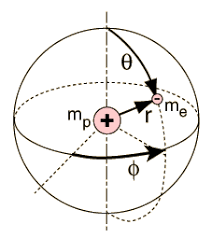
The hydrogen atom is one of the simplest quantum mechanical systems and can be described qualitatively using several key concepts. First, the electron in the hydrogen atom is not confined to a specific location in space but rather exists in a “cloud” of probability called the electron density. The electron density gives the probability of…

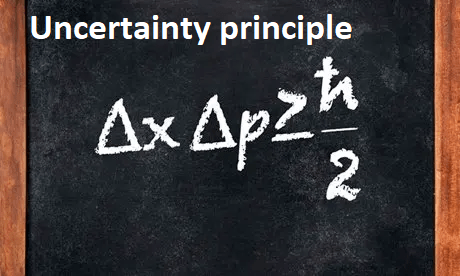
Uncertainty principle

The uncertainty principle is a fundamental principle of quantum mechanics, which states that certain pairs of physical properties of a particle, such as position and momentum, cannot both be precisely determined or known simultaneously. This means that the more accurately we know the position of a particle, the less precisely we can know its momentum,…

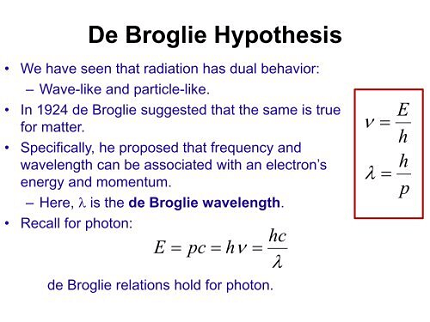
De Broglie hypothesis

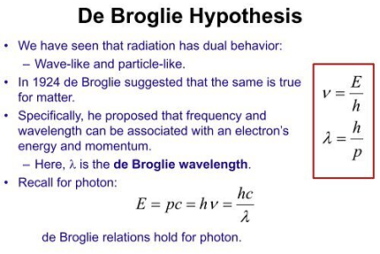
The De Broglie hypothesis, proposed by French physicist Louis de Broglie in 1924, suggests that all matter, including particles such as electrons and protons, exhibits wave-like properties. According to the hypothesis, particles have both particle-like and wave-like characteristics, and the wavelength of these particles is inversely proportional to their momentum. This means that the more…

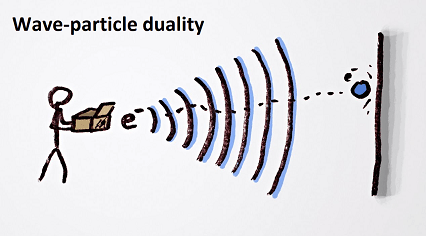
Wave-particle duality

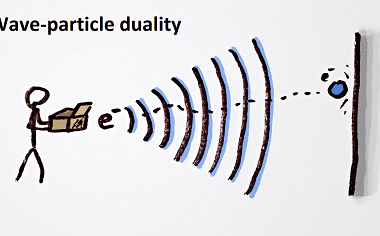
Wave-particle duality is a fundamental concept in physics that describes the nature of matter and light. It refers to the fact that particles, such as electrons and photons, can exhibit both wave-like and particle-like properties, depending on how they are observed and measured. In some experiments, particles behave as discrete, localized particles with a definite…

Spectrum of hydrogen atom

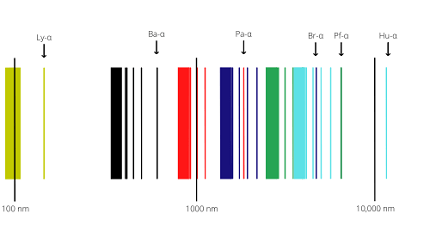
The spectrum of a hydrogen atom refers to the specific frequencies of electromagnetic radiation that are emitted or absorbed when an electron in a hydrogen atom changes from one energy level to another. The spectrum of hydrogen can be divided into several series, including the Lyman, Balmer, Paschen, Brackett, and Pfund series. The Lyman series…

Bohr model

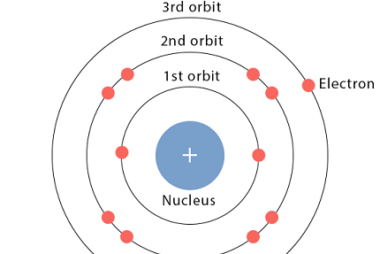
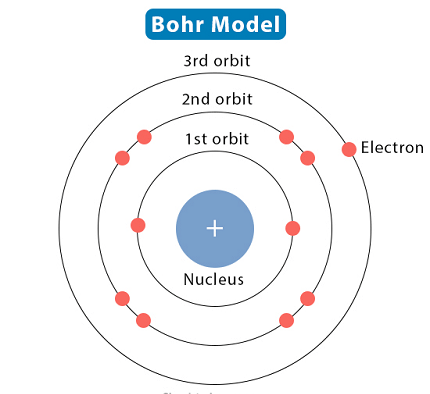
The Bohr model is a simple model of the atom proposed by Danish physicist Niels Bohr in 1913. It was an early attempt to explain the behavior of electrons in an atom and the spectrum of light emitted by atoms. The Bohr model posits that electrons move in circular orbits around the nucleus of an…

Viscosity

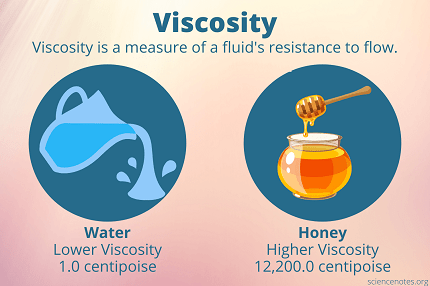
Viscosity is a measure of a fluid’s resistance to flow. In simpler terms, it is the internal friction between different layers of fluid as they move past each other. Viscosity is commonly measured in units of poise or centipoise, and is dependent on factors such as temperature, pressure, and composition of the fluid. Fluids with…