Vrindawan Coaching Center

Section formulae

The section formula is a formula used in analytical geometry to find the coordinates of a point that divides a line segment into two parts in a given ratio. Let A(x1, y1) and B(x2, y2) be two points in a coordinate plane, and let M(x, y) be a point on the line segment AB that…

Distance between two points

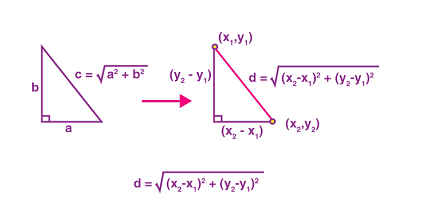
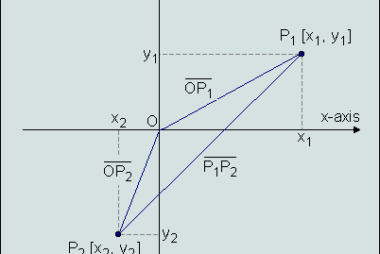
In analytical geometry, the distance between two points in a plane is given by the distance formula: d = sqrt((x2 – x1)^2 + (y2 – y1)^2) where (x1, y1) and (x2, y2) are the coordinates of the two points and d is the distance between them. To use the formula, simply substitute the values of…

Two dimensions: Cartesian coordinates

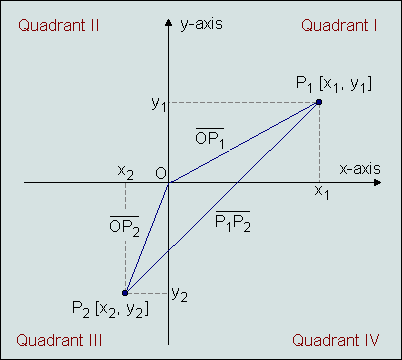
Analytical geometry in two dimensions is the branch of mathematics that deals with the study of geometric shapes using algebraic methods. The Cartesian coordinate system is the most common system used in analytical geometry, and it allows us to represent points, lines, curves, and other geometric figures using numerical values. In the Cartesian coordinate system,…

Inverse trigonometric functions (principal value only) and their elementary properties

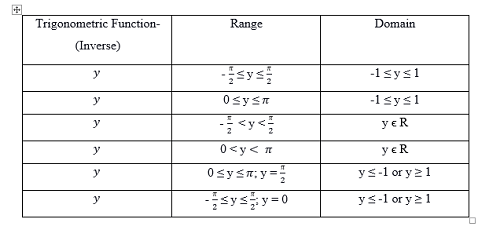
Inverse trigonometric functions are functions that return the angle whose trigonometric ratio is a given value. Here are the principal value only of inverse trigonometric functions and their elementary properties: It is important to note that inverse trigonometric functions are not always unique, as they depend on the quadrant in which the angle lies. For…

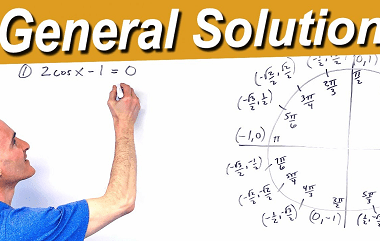
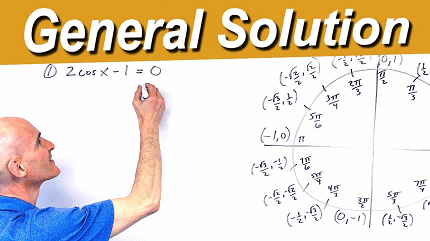
General solution of trigonometric equations

Trigonometric equations are equations that involve trigonometric functions such as sine, cosine, tangent, etc. Solving trigonometric equations involves finding values of the variable that make the equation true. The general strategy for solving trigonometric equations is to use algebraic techniques to transform the equation into an equivalent equation that is easier to solve. Here are…

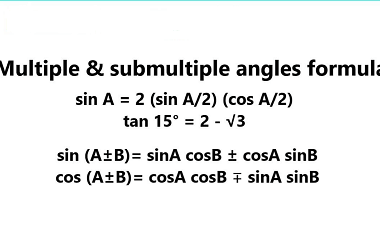
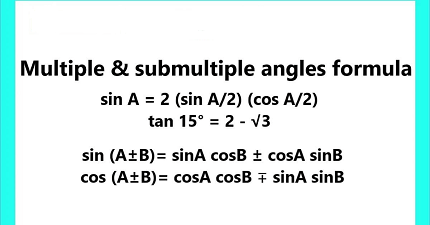
Formulae involving multiple and sub-multiple angles

Here are some of the commonly used trigonometric formulas involving multiple and sub-multiple angles: These formulas can be used to simplify trigonometric expressions, solve equations, and prove identities. What is Required Formulae involving multiple and sub-multiple angles Here are some of the commonly used required trigonometric formulas involving multiple and sub-multiple angles: These formulas can…

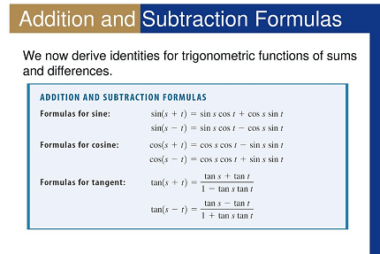
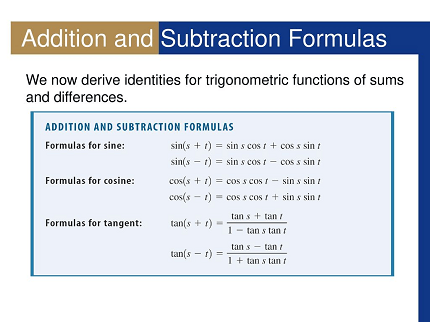
Addition and subtraction formulae

Trigonometry addition and subtraction formulas are used to find the trigonometric functions of the sum or difference of two angles. There are several formulas for each of the six trigonometric functions: sine, cosine, tangent, cosecant, secant, and cotangent. Here are the trigonometry addition and subtraction formulas: sin(A+B) = sin(A)cos(B) + cos(A)sin(B) sin(A-B) = sin(A)cos(B) –…

Their periodicity and graphs

Trigonometry is a branch of mathematics that deals with the study of relationships involving angles and the sides of triangles. It has many practical applications in fields such as engineering, physics, and astronomy. One of the most important aspects of trigonometry is the periodicity of the trigonometric functions. The six trigonometric functions are sine, cosine,…

Trigonometric functions

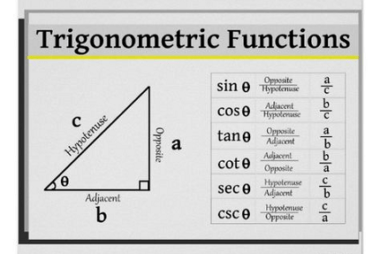
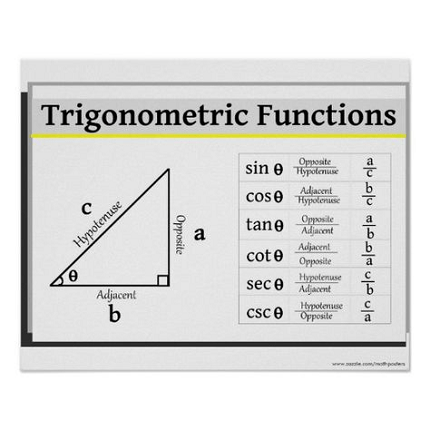
Trigonometric functions are mathematical functions that relate the angles of a right triangle to the lengths of its sides. The most commonly used trigonometric functions are sine (sin), cosine (cos), and tangent (tan). These functions can be defined in terms of the sides of a right triangle as follows: In addition to these three functions,…

Mean and variance of the random variable

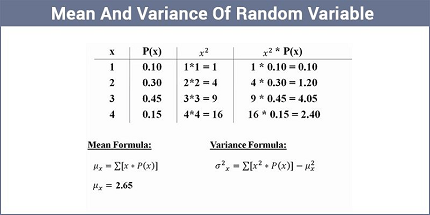
The mean of a random variable is also known as its expected value. It is a measure of the central tendency of the distribution of the random variable. The expected value of a discrete random variable X with possible values x1, x2, …, xn and corresponding probabilities P(X = x1), P(X = x2), …, P(X…