Vrindawan Coaching Center

Superposition of waves

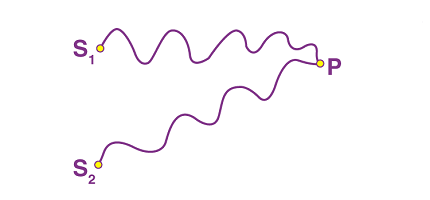
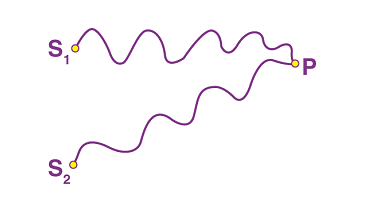
Superposition of waves is a phenomenon that occurs when two or more waves meet at the same point in space and time. When this happens, the displacement of the medium at that point is equal to the sum of the individual displacements of each wave. This means that the waves add up to form a…
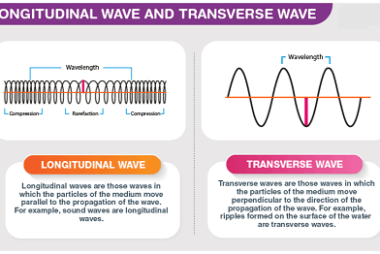
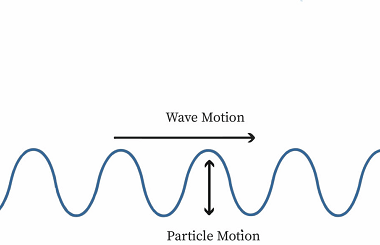
Longitudinal and Transverse waves

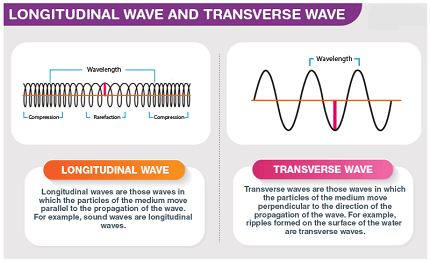
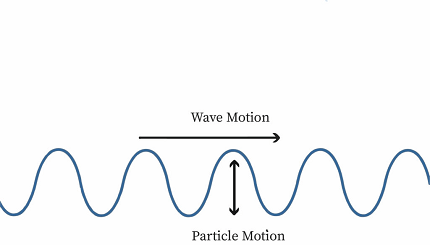
Longitudinal waves and transverse waves are two types of waves that are distinguished based on the direction of the wave propagation and the direction of the vibration of the particles in the medium through which the wave travels. A longitudinal wave is a wave in which the particles of the medium vibrate parallel to the…

Wave motion (plane waves only)

Wave motion refers to the propagation of disturbances or oscillations through a medium. A plane wave is a type of wave that propagates uniformly in one direction and has a constant frequency, wavelength, and amplitude. In a plane wave, the wavefronts are planes perpendicular to the direction of propagation, and the oscillations of the medium…

Bernoulli’s theorem

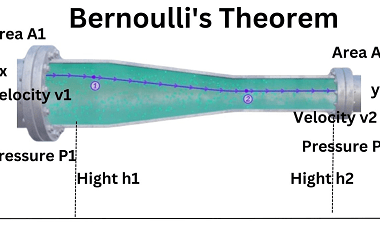
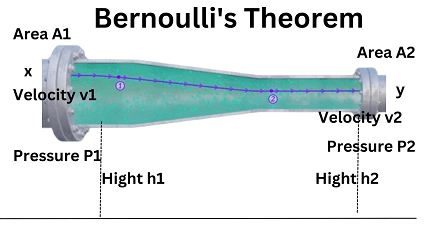
Bernoulli’s theorem, named after the Swiss mathematician Daniel Bernoulli, is a fundamental principle of fluid dynamics that describes the relationship between the pressure, velocity, and elevation of a fluid in motion. It states that as the speed of a fluid increases, the pressure within the fluid decreases, and vice versa. In mathematical terms, Bernoulli’s theorem…

Equation of Continuity

The equation of continuity is a fundamental principle in fluid dynamics, which states that the mass flow rate of an incompressible fluid through a pipe or channel must remain constant. Mathematically, this can be expressed as: ρAv = constant where: According to the equation, if the cross-sectional area of the pipe decreases, the fluid velocity…

Streamline flow

Streamline flow is a type of fluid flow where the velocity of the fluid is constant along each streamline. Streamlines are imaginary lines that represent the direction of the fluid flow at each point in space. In streamline flow, the fluid particles move in a smooth, organized manner, without any turbulence or mixing. Streamline flow…

Terminal velocity

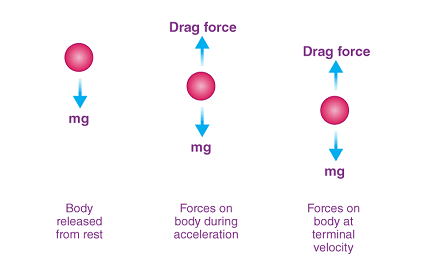
Terminal velocity is the maximum velocity that a falling object can reach when the resistance of the medium through which it is falling (such as air or water) balances the force of gravity. At terminal velocity, the object stops accelerating and falls at a constant speed. The terminal velocity of an object depends on its…

Stoke’s law

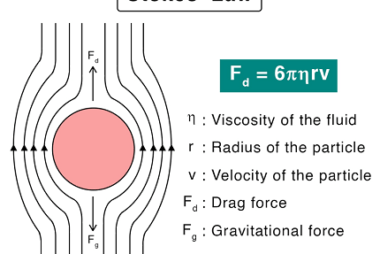
Stoke’s law is a scientific principle that describes the behavior of small particles that are suspended in a fluid medium. The law states that the force of viscous drag on a spherical particle in a fluid is directly proportional to the velocity of the particle and the viscosity of the fluid and inversely proportional to…

Bulk modulus in Mechanics

In mechanics, the bulk modulus is a measure of the resistance of a material to compression. It is defined as the ratio of the change in pressure to the fractional change in volume, under conditions of constant temperature. Mathematically, the bulk modulus (K) can be expressed as: K = – V ΔP / ΔV where…

Modulus of rigidity

The modulus of rigidity, also known as shear modulus, is a material property that describes its resistance to shearing deformations. It is defined as the ratio of the shearing stress to the shearing strain within the proportional limit of the material. The modulus of rigidity is denoted by the symbol G and is measured in…