Vrindawan Coaching Center

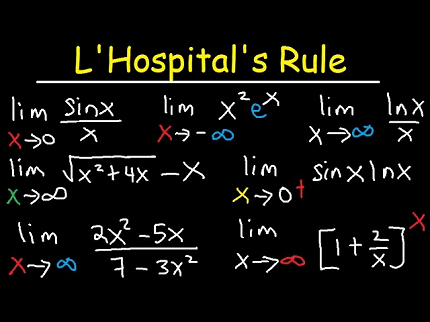
L’Hospital rule of evaluation of limits of functions

L’Hôpital’s rule is a technique used to evaluate limits of functions of the form “f(x)/g(x)” where both f(x) and g(x) approach zero (or infinity) as x approaches a particular value. The rule states that if the limit of the quotient of the derivatives of f(x) and g(x) exists, then this limit is equal to the…


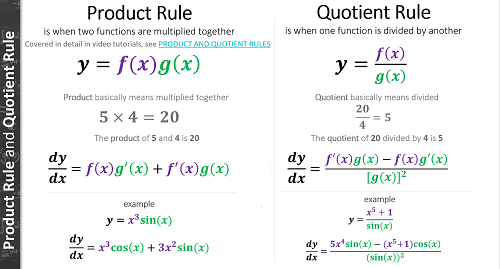
Product and Quotient of two functions

The product of two functions is obtained by multiplying the two functions together at each point in their domain. If f(x) and g(x) are two functions, their product is denoted as f(x) * g(x) and is defined as: (f * g)(x) = f(x) * g(x) For example, if f(x) = x^2 and g(x) = 3x,…

Differential Calculus Difference

Differential calculus is a branch of mathematics that deals with the study of rates of change and slopes of curves. It focuses on finding the derivative of a function, which is the instantaneous rate of change of the function at a particular point. The derivative gives us information about the steepness of a curve at…

limit and continuity of the sum

Let $f(x)$ and $g(x)$ be two functions, and let $c$ be a real number. The sum of the two functions $f(x)$ and $g(x)$ is defined by $(f+g)(x) = f(x) + g(x)$ for all $x$ in the domain of both functions. To determine if the sum of $f(x)$ and $g(x)$ is continuous at $c$, we need…

Continuity of a function

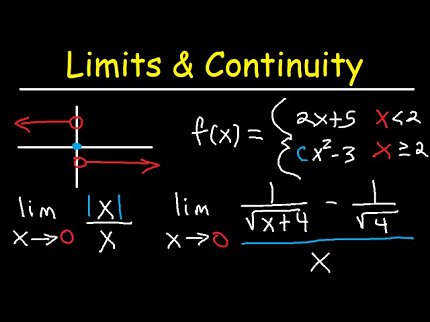
Continuity is a fundamental concept in calculus that describes how a function behaves at every point in its domain. A function is said to be continuous if it has no abrupt jumps, breaks, or holes in its graph. More formally, a function f(x) is continuous at a point x=a if three conditions are met: If…

Limit of a function at a real number

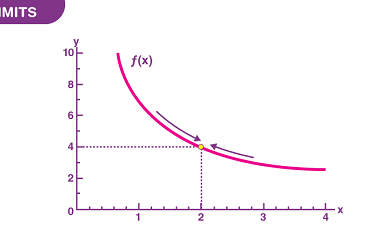
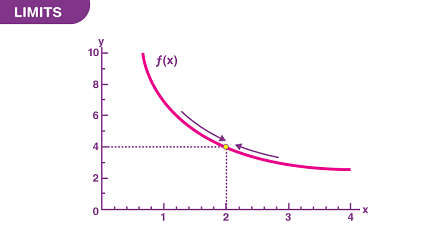
The limit of a function at a real number is a fundamental concept in calculus that describes the behavior of a function as the input values approach a specific real number. Formally, we say that the limit of a function f(x) as x approaches a real number c is L if for every ε >…

Coplanar lines

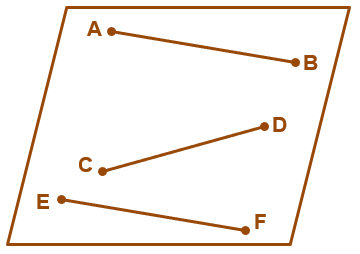
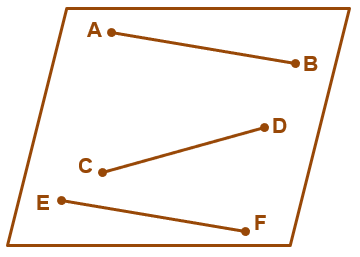
Coplanar lines are lines that lie on the same plane. In other words, any two points on each of the lines can be connected with a straight line that lies entirely in the same plane. For example, if two lines intersect, they are coplanar because the plane containing one line also contains the other line.…

Angle between a line and the plane

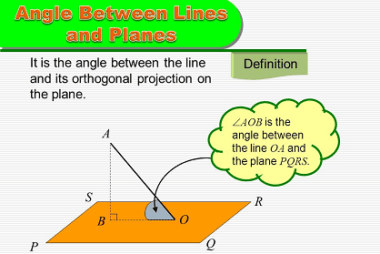
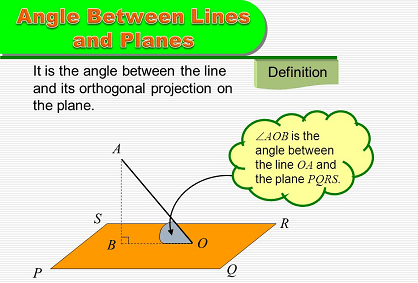
The angle between a line and a plane is the angle formed by the intersection of the line and the plane. This angle is measured as the acute angle between the line and the plane, i.e., the smallest angle between them. To calculate the angle between a line and a plane, you can use the…

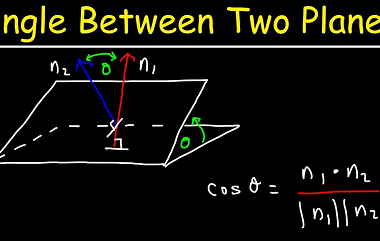
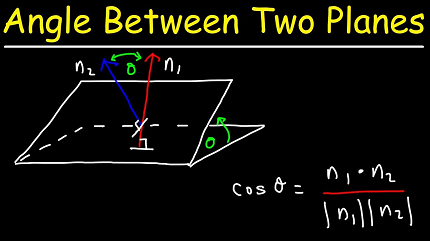
Angle between two planes

The angle between two planes is the angle formed between their normal vectors. To find the normal vectors of two planes, you can use the cross product of their respective direction vectors. Let’s say we have two planes represented by their equations: Plane 1: ax + by + cz + d1 = 0 Plane 2:…

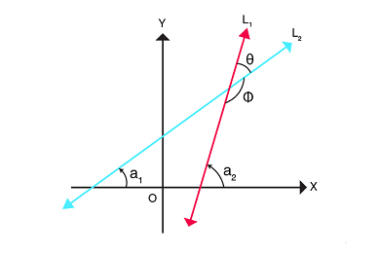
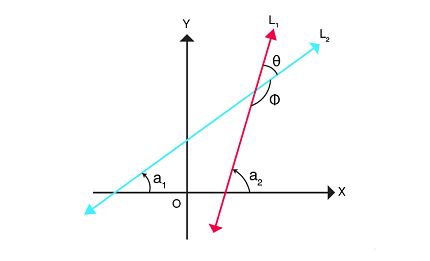
Angle between two lines

The angle between two lines can be found using the slope of each line. If the slopes of the lines are m1 and m2, then the angle between the lines is given by the formula: θ = arctan(|(m1 – m2)/(1 + m1*m2)|) where arctan is the inverse tangent function. Note that the absolute value is…