Vrindawan Coaching Center

Half-life and Mean life

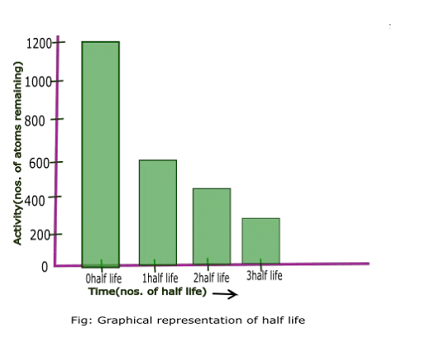
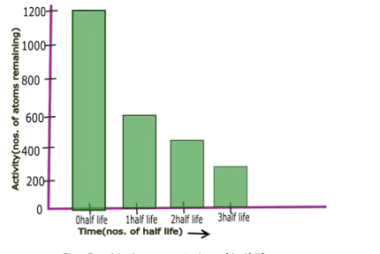
In the context of radioactivity, half-life and mean life are two important concepts that describe the decay of a radioactive substance over time. Half-life refers to the amount of time it takes for half of the original quantity of a radioactive substance to decay. For example, if you start with 100 grams of a substance…

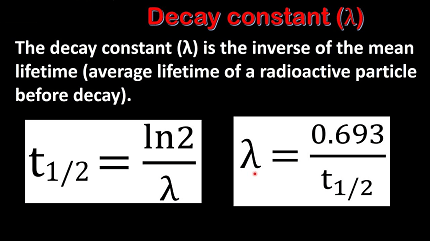
Decay constant

The decay constant, usually denoted by the symbol λ (lambda), is a fundamental parameter in radioactive decay. It is the rate at which a radioactive substance decays, or the probability of decay per unit time. Mathematically, the decay constant can be defined as the ratio of the number of radioactive nuclei that decay in a…

Law of radioactive decay

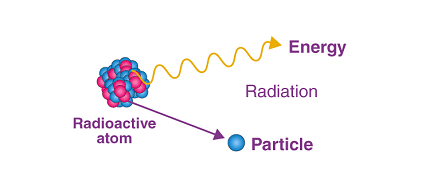
The law of radioactive decay is a fundamental principle of nuclear physics that describes the process by which unstable atomic nuclei spontaneously emit radiation and transform into more stable nuclei. This process is known as radioactive decay. The law of radioactive decay states that the rate of decay of a radioactive substance is proportional to…

α, β and γ radiations

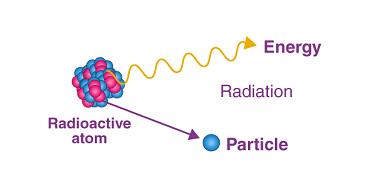
Alpha (α), beta (β), and gamma (γ) radiation are three types of ionizing radiation emitted by radioactive elements. Alpha radiation consists of positively charged particles made up of two protons and two neutrons, which is essentially a helium nucleus. It is relatively heavy and has a short range in air, typically traveling only a few…

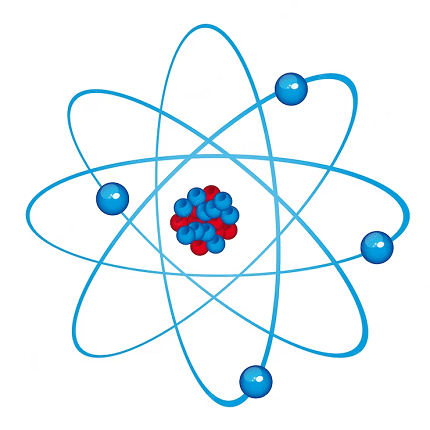
Atomic nucleus

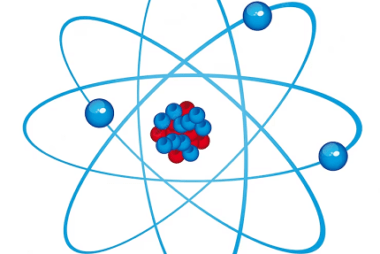
An atomic nucleus is the central part of an atom that contains most of the atom’s mass. It is composed of protons and neutrons, which are collectively called nucleons. Protons have a positive charge, while neutrons are neutral. The number of protons in the nucleus is called the atomic number and determines the element to…

Polaroids

Polaroids are instant cameras that were first introduced by the Polaroid Corporation in the late 1940s. The cameras produce a physical print of the photograph immediately after it is taken, which sets them apart from traditional cameras that require film to be developed before the image can be seen. Polaroids work by using a special…

Brewster’s law

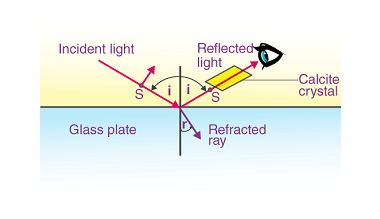
Brewster’s law, named after Scottish physicist Sir David Brewster, describes the relationship between the angle of incidence of light and the polarization of reflected light. Specifically, the law states that when light is incident on a surface at a particular angle known as the Brewster angle, the reflected light becomes completely polarized, meaning that it…

Plane Polarized light

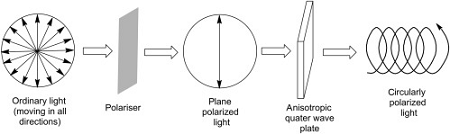
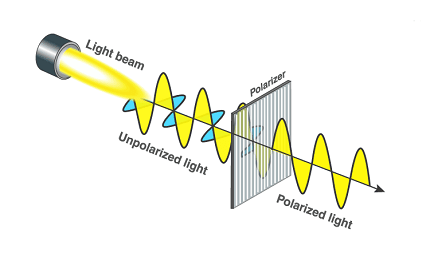
Plane polarized light is a type of light in which the electric field oscillates in a single plane perpendicular to the direction of propagation. This means that the light waves are all vibrating in the same direction, which gives them a distinct orientation. There are several ways to produce polarized light, such as passing unpolarized…

Polarization of light

Polarization of light refers to the orientation of the electric field vector of an electromagnetic wave. In an unpolarized beam of light, the electric field vector points in random directions perpendicular to the direction of propagation. When the light is polarized, the electric field vector oscillates in a particular direction. There are different methods by…

Diffraction due to a single slit

Diffraction is the bending and spreading of waves as they pass through an aperture or around an obstacle. When a wave, such as light, passes through a narrow slit, the wave is diffracted and spreads out, producing a pattern of alternating bright and dark fringes on a screen placed behind the slit. This is known…