Vrindawan Coaching Center

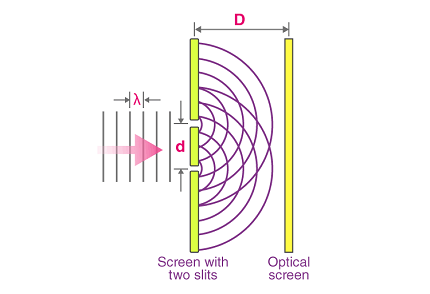
Interference limited to Young’s double slit experiment

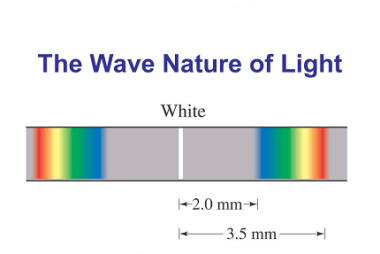
In Young’s double-slit experiment, interference occurs due to the wave nature of light. When a beam of light is shone onto two closely spaced slits, the light passing through each slit diffracts and spreads out as if each slit was a new source of light. These two sets of waves then overlap and interfere with…
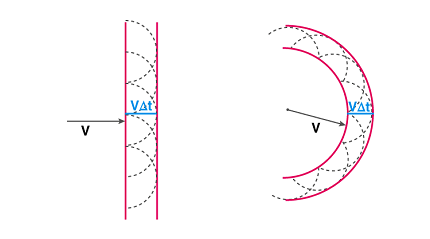
Huygen’s principle

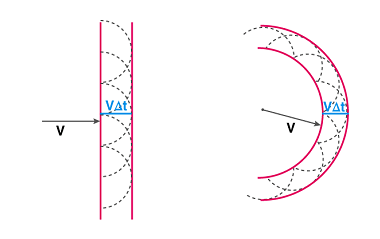
Huygen’s principle, named after the Dutch physicist Christiaan Huygens, is a fundamental principle in wave optics that explains how waves propagate through a medium. According to Huygen’s principle, each point on a wavefront can be considered as a source of secondary spherical waves. These secondary waves travel outwards from each point in all directions at…

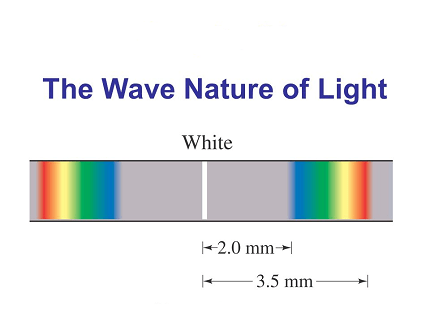
Wave nature of light

The wave nature of light is one of the fundamental properties of electromagnetic radiation, which includes light as well as other types of electromagnetic waves such as radio waves, microwaves, X-rays, and gamma rays. According to the wave theory of light, light is a form of energy that travels through space in the form of…

Magnification

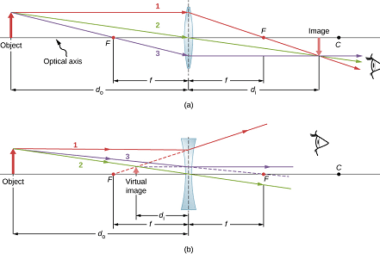
Magnification refers to the process of making something appear larger than it actually is. In optics, magnification is the ratio of the size of an image produced by a lens or mirror to the size of the object being viewed. Magnification can be expressed as a numerical value or as a percentage. In microscopy, magnification…

Combinations of mirrors

When two mirrors are placed facing each other, an infinite number of reflections can be seen, creating a series of smaller and smaller images. This effect is called a mirror maze or a hall of mirrors. When three mirrors are placed together in a triangular formation, the images that are reflected create a complex pattern.…

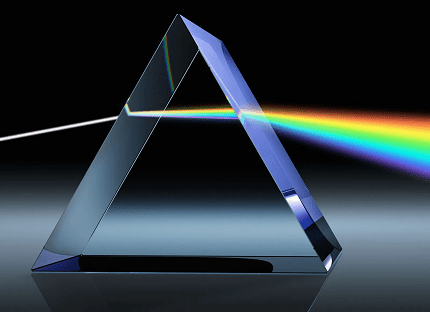
Dispersion of light by a prism

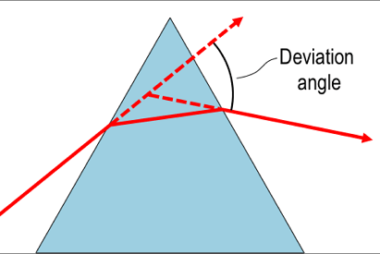
When light passes through a prism, it undergoes dispersion, which means that the different colors of light that make up white light are separated and spread out. This happens because each color of light has a slightly different wavelength and therefore bends at a slightly different angle as it enters and exits the prism. The…

Deviation

Deviation generally refers to a departure or divergence from a standard, norm, or expected behavior or outcome. It can be used in various contexts, including statistics, science, engineering, and management. In statistics, deviation refers to the difference between a data point and the mean of a data set. It is commonly measured as standard deviation,…

Total internal reflection

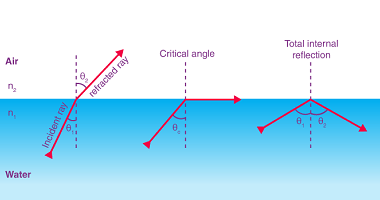
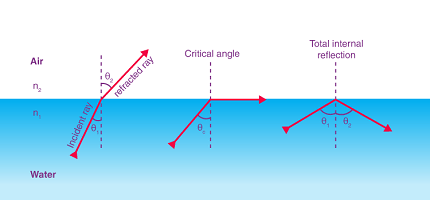
Total internal reflection is a phenomenon that occurs when a light ray passes from a medium with a higher refractive index to a medium with a lower refractive index at an angle greater than the critical angle. When this happens, the light ray is reflected back into the higher refractive index medium rather than being…

Spherical surfaces

Spherical surfaces are three-dimensional surfaces that have the same curvature in all directions. They are often described mathematically using the equation of a sphere: (x-a)^2 + (y-b)^2 + (z-c)^2 = r^2 where (a,b,c) is the center of the sphere, and r is its radius. Spherical surfaces can be found in many different contexts, such as…