Vrindawan Coaching Center

Alloys

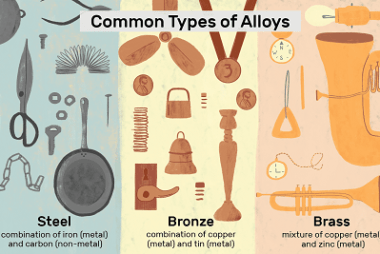
An alloy is a combination of two or more metals, or a metal and another element, that results in a material with improved properties such as increased strength, hardness, or resistance to corrosion. Alloys are usually formed by mixing molten metals together and allowing them to cool and solidify. The resulting material has a unique…
Interstitial compounds

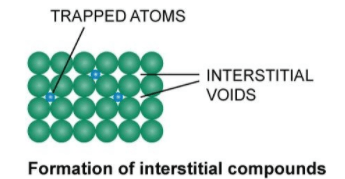
Interstitial compounds are compounds that are formed by inserting atoms or smaller molecules into the interstices or voids of a host crystal lattice. These compounds are usually formed by chemically reacting the host lattice with an appropriate guest molecule or atom. One example of an interstitial compound is interstitial solid solutions, which are formed when…

Standard electrode potentials

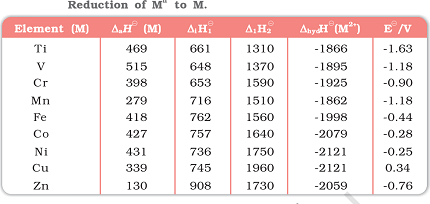
Here are the standard electrode potentials of some d-block elements: Element Standard electrode potential (V) Scandium (Sc) -2.58 Titanium (Ti) -1.63 Vanadium (V) -1.18 Chromium (Cr) -0.91 Manganese (Mn) -1.18 to -1.57 (depending on oxidation state) Iron (Fe) -0.44 to -0.77 (depending on oxidation state) Cobalt (Co) -0.28 Nickel (Ni) -0.25 Copper (Cu) +0.34 Zinc…

Oxidation states and their stability

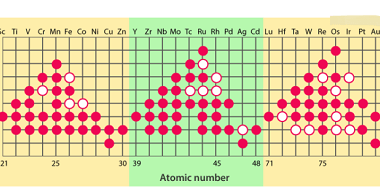
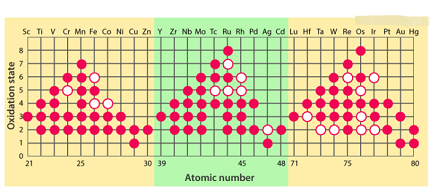
Oxidation state is a measure of the degree of oxidation of an atom in a chemical compound. It is represented by a positive or negative number, indicating the degree of electron loss or gain by an atom. The stability of oxidation states depends on several factors, including the electronegativity of the elements involved, the size…

Group 18 Compounds of xenon with fluorine and oxygen

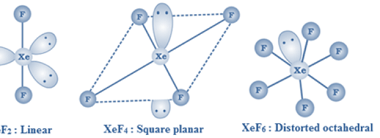
Xenon, a noble gas, can form compounds with fluorine and oxygen due to its large atomic size and availability of d-orbitals. Overall, the xenon-fluorine and xenon-oxygen compounds are quite reactive and can be dangerous to handle. However, they have important applications in industries such as electronics, materials science, and aerospace. What is Required p-Block Elements…

Group 18 Chemical properties and uses

Group 18 of the periodic table, also known as the noble gases, includes helium (He), neon (Ne), argon (Ar), krypton (Kr), xenon (Xe), and radon (Rn). These elements are all chemically stable and have a complete outermost shell of electrons, making them very unreactive. Here are some of the chemical properties and uses of these…

Group 17 Bleaching powder

Group 17 in the periodic table includes the elements fluorine (F), chlorine (Cl), bromine (Br), iodine (I), and astatine (At). Bleaching powder, also known as calcium hypochlorite (Ca(ClO)2), is a compound that contains both calcium and chlorine. Bleaching powder is often used as a disinfectant and bleaching agent for textiles, paper pulp, and hair. When…

Group 17 Oxoacids of halogens

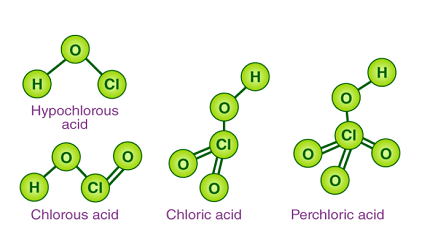
The Group 17 halogens, also known as the halides, form a series of oxoacids with varying numbers of oxygen atoms. The oxoacids of the halogens are named based on the number of oxygen atoms in the molecule and the oxidation state of the halogen. Here are the oxoacids of the halogens: The oxoacids of the…

Group 17 Hydrogen chloride and Interhalogen compounds

Group 17, also known as the halogens, includes elements such as fluorine, chlorine, bromine, iodine, and astatine. Hydrogen chloride is a compound composed of hydrogen and chlorine, while interhalogen compounds are compounds composed of two different halogens. Hydrogen chloride (HCl) is a colorless gas that dissolves readily in water to form hydrochloric acid. It is…

Group 17 Uses of chlorine

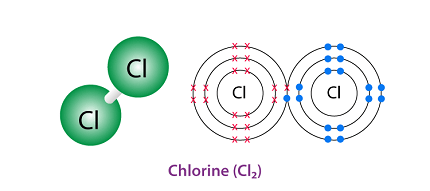
Group 17 in the periodic table contains the halogens, including chlorine. Chlorine has many uses, some of which are: What is Required p-Block Elements Group 17 Uses of chlorine The p-Block elements in Group 17 of the periodic table are known as the halogens, and include chlorine. The uses of chlorine are as follows: Overall,…