Vrindawan Coaching Center

Its calculation

Modern Physics is a branch of physics that deals with the study of phenomena that occur at the atomic and subatomic level. It includes the study of quantum mechanics, relativity, particle physics, and astrophysics. The calculations involved in modern physics are often complex and require a good understanding of mathematical concepts such as calculus, differential…
Brewster’s law

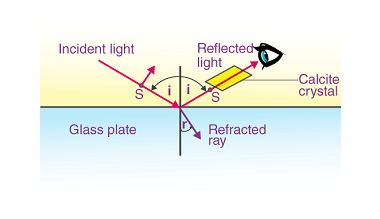
Brewster’s law, named after Scottish physicist Sir David Brewster, describes the relationship between the angle of incidence of light and the polarization of reflected light. Specifically, the law states that when light is incident on a surface at a particular angle known as the Brewster angle, the reflected light becomes completely polarized, meaning that it…

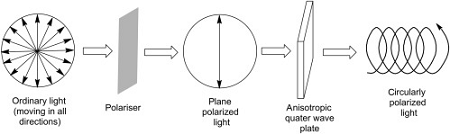
Plane Polarized light

Plane polarized light is a type of light in which the electric field oscillates in a single plane perpendicular to the direction of propagation. This means that the light waves are all vibrating in the same direction, which gives them a distinct orientation. There are several ways to produce polarized light, such as passing unpolarized…

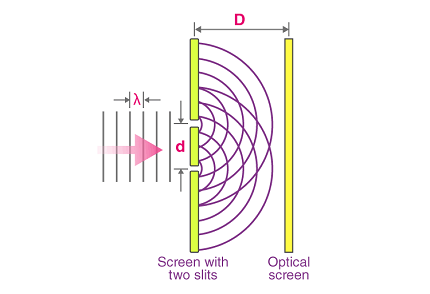
Interference limited to Young’s double slit experiment

In Young’s double-slit experiment, interference occurs due to the wave nature of light. When a beam of light is shone onto two closely spaced slits, the light passing through each slit diffracts and spreads out as if each slit was a new source of light. These two sets of waves then overlap and interfere with…

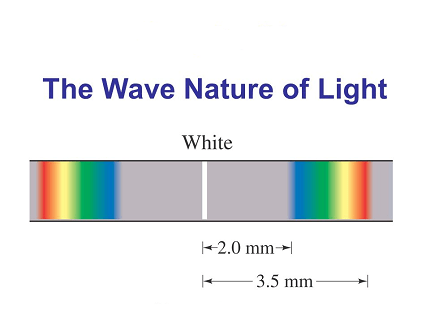
Wave nature of light

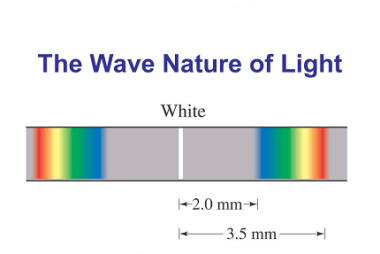
The wave nature of light is one of the fundamental properties of electromagnetic radiation, which includes light as well as other types of electromagnetic waves such as radio waves, microwaves, X-rays, and gamma rays. According to the wave theory of light, light is a form of energy that travels through space in the form of…

Magnification

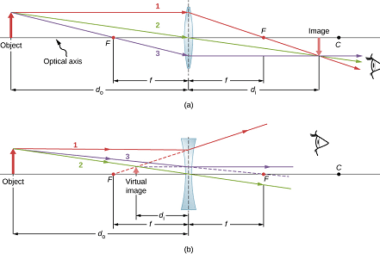
Magnification refers to the process of making something appear larger than it actually is. In optics, magnification is the ratio of the size of an image produced by a lens or mirror to the size of the object being viewed. Magnification can be expressed as a numerical value or as a percentage. In microscopy, magnification…

Combinations of mirrors

When two mirrors are placed facing each other, an infinite number of reflections can be seen, creating a series of smaller and smaller images. This effect is called a mirror maze or a hall of mirrors. When three mirrors are placed together in a triangular formation, the images that are reflected create a complex pattern.…

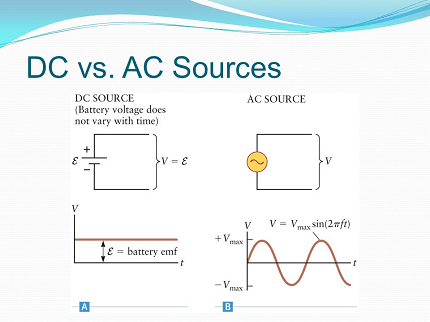
With d.c. and a.c. sources

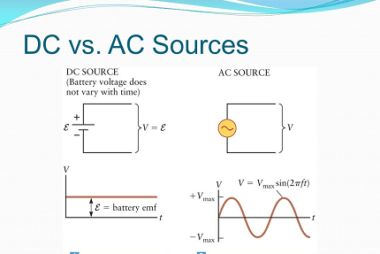
DC (direct current) and AC (alternating current) are two types of electrical power sources. DC sources provide a steady and constant flow of electrical energy in one direction. Batteries, fuel cells, and photovoltaic cells are common examples of DC sources. AC sources, on the other hand, provide electrical energy that alternates in direction and magnitude…

RC, LR, LC and LCR(in series) circuits

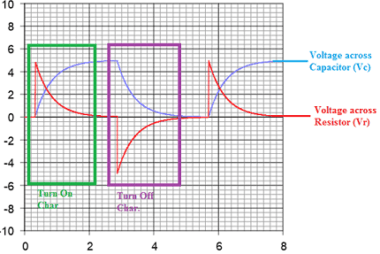
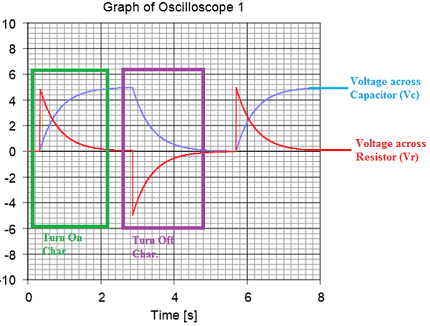
RC, LR, LC, and LCR are different types of electrical circuits that consist of resistors (R), capacitors (C), and inductors (L). RC Circuit: An RC circuit is a circuit that consists of a resistor and a capacitor connected in series or parallel. In a series RC circuit, the resistor and capacitor are connected in series,…