Vrindawan Coaching Center

Self and Mutual Inductance

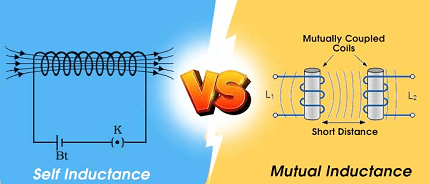
Self-inductance and mutual inductance are two important concepts in the field of electromagnetism. Self-inductance refers to the property of a circuit element, such as a coil or solenoid, to generate an electromotive force (EMF) in itself when the current through it changes. The EMF produced is proportional to the rate of change of the current…

Ammeter

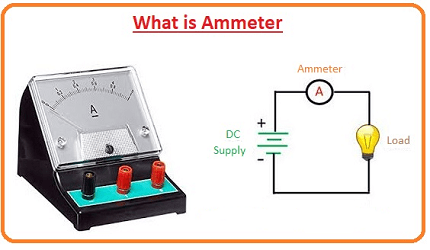
An ammeter is a device used to measure the electric current in a circuit. It is typically connected in series with the circuit, which means that the current flows through the ammeter itself. The unit of measurement for electric current is the ampere (A), so an ammeter will measure the current in amperes. Ammeters are…

Moving coil galvanometer

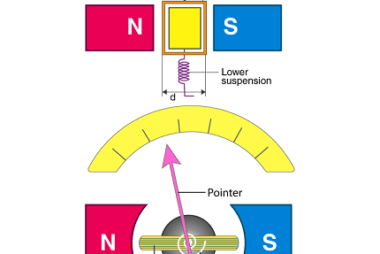
A moving coil galvanometer is an instrument used to measure small electric currents. It consists of a coil of wire suspended between the poles of a permanent magnet. When a current flows through the coil, it experiences a torque due to the interaction between the magnetic field of the coil and the magnetic field of…

Effect of a uniform magnetic field on a current loop

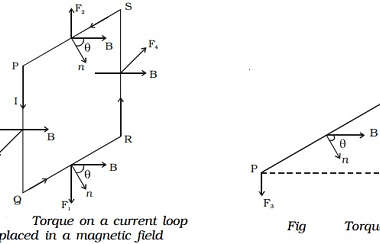
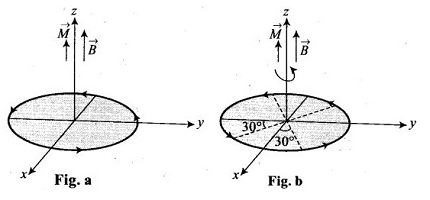
When a current loop is placed in a uniform magnetic field, it experiences a torque that tends to align the plane of the loop perpendicular to the direction of the magnetic field. This is known as the magnetic moment of the current loop. The torque acting on the current loop is given by the equation:…

Magnetic moment of a current loop

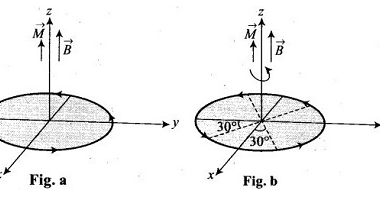
The magnetic moment of a current loop is a measure of the strength of its magnetic field. It is defined as the product of the current in the loop and the area enclosed by the loop, and is given by the equation: μ = I A where μ is the magnetic moment, I is the…

Magnetic field near a current-carrying straight wire

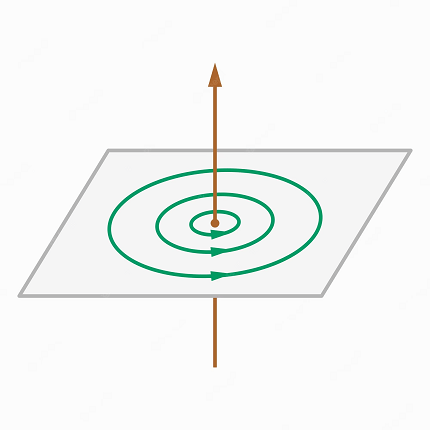
When an electric current flows through a straight wire, it creates a magnetic field around the wire. This magnetic field is known as the “magnetic field near a current-carrying straight wire.” The magnetic field is perpendicular to the wire and its direction is given by the right-hand rule. If you point your right thumb in…

Biot–Savart’s law

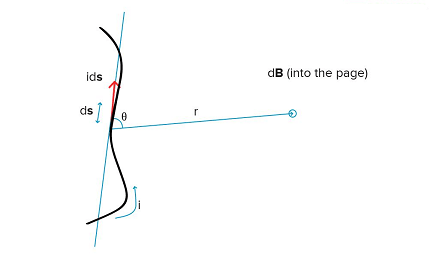
Biot-Savart’s law is a fundamental law in electromagnetism that describes the magnetic field produced by a steady current in a wire. It states that the magnetic field at a point in space due to a current-carrying wire is directly proportional to the current in the wire and the length of the wire segment, and inversely…

Heating effect of current

The heating effect of current refers to the phenomenon of electrical energy being converted into heat energy when a current flows through a conductor. The amount of heat produced is directly proportional to the square of the current, the resistance of the conductor, and the time for which the current flows. This effect is commonly…

Simple applications

There are countless simple applications that can be developed depending on the platform and programming language used. Here are a few examples: These are just a few examples of simple applications that can be developed. The possibilities are endless, and the complexity of the app will depend on the user’s requirements and the platform they…

Parallel arrangements of resistances

When resistors are arranged in parallel, they are connected in such a way that the same voltage is applied across each resistor, and the current is divided among the resistors. The total resistance of the parallel circuit is less than the value of the smallest resistor in the circuit. The current flowing through each resistor…