Vrindawan Coaching Center

Ohm’s law

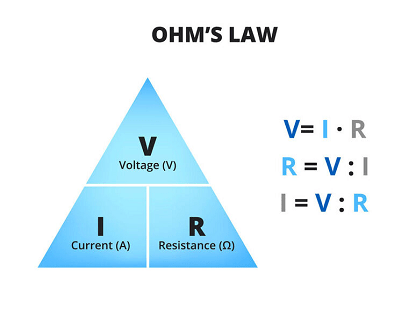
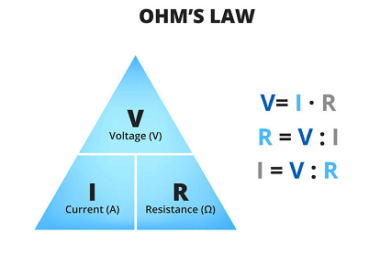
Ohm’s law is a fundamental law of electrical engineering and physics that describes the relationship between electric current, voltage, and resistance in a conductor. It states that the current flowing through a conductor between two points is directly proportional to the voltage across the two points and inversely proportional to the resistance between them. Mathematically,…

Electric current

Electric current refers to the flow of electric charge in a conductor or circuit. It is the rate at which electric charges, typically electrons, move through a material. The unit of electric current is the ampere (A), which is defined as the flow of one coulomb of charge per second. Electric current can be either…

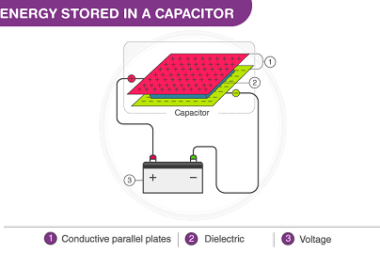
Energy stored in a capacitor

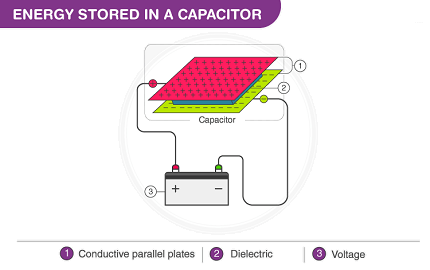
The energy stored in a capacitor is given by the formula: E = (1/2) * C * V^2 where E is the energy stored in joules, C is the capacitance of the capacitor in farads, and V is the voltage across the capacitor in volts. This formula shows that the energy stored in a capacitor…

Capacitors in Series and Parallel

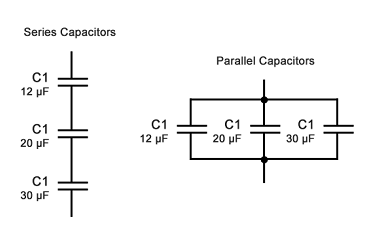
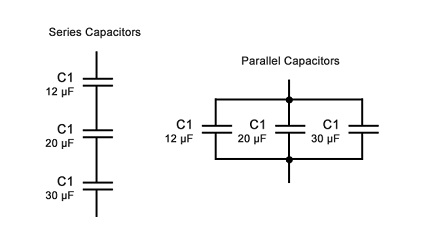
Capacitors are electronic components that store electrical charge and energy. They are commonly used in circuits to filter signals, block direct current, and stabilize voltage. When capacitors are connected in series, their total capacitance decreases, and their total voltage rating increases. This is because the charge on each capacitor is the same, and the voltage…

Capacitance

Capacitance is a measure of a capacitor’s ability to store electric charge. A capacitor is an electronic component that consists of two conductive plates separated by a dielectric material, such as air or a non-conductive plastic. When a voltage is applied across the plates, electrons from one plate accumulate on the other, creating an electric…

Gauss’s law

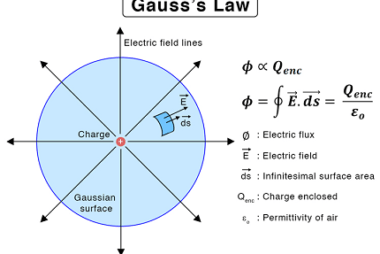
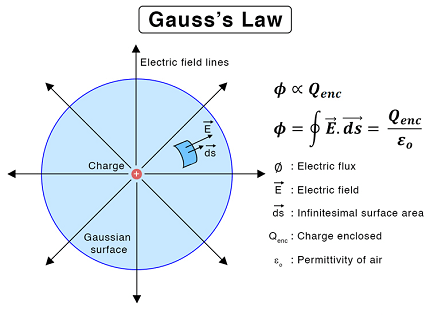
Gauss’s law is a fundamental law of electromagnetism that relates the distribution of electric charge to the resulting electric field. The law states that the electric flux through any closed surface is proportional to the total amount of electric charge enclosed within the surface. In mathematical terms, Gauss’s law can be expressed as: ∮S E…

Flux of electric field

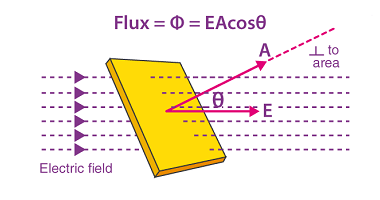
The flux of an electric field is the measure of the number of electric field lines passing through a given surface. It is defined as the electric field strength multiplied by the area of the surface, multiplied by the cosine of the angle between the electric field and the normal to the surface. The mathematical…

Electrical dipoles in a uniform electrostatic field

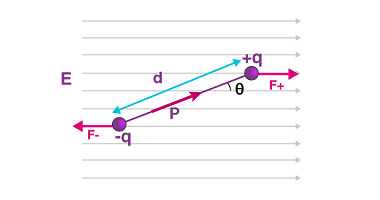
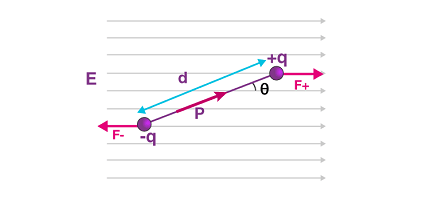
In a uniform electrostatic field, an electric dipole experiences a torque that tends to align the dipole moment vector with the direction of the field. The magnitude of the torque is given by the vector product of the dipole moment vector and the electric field vector. If the dipole moment vector is not aligned with…

Electrical potential energy of a system of point charges

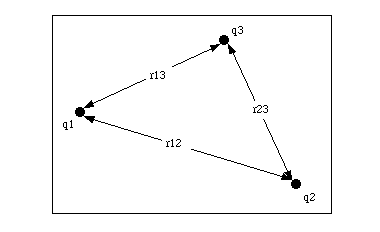
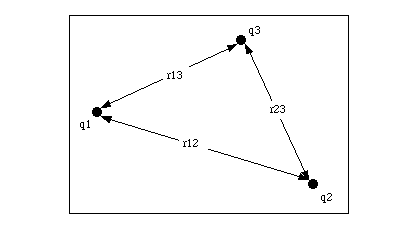
The electrical potential energy of a system of point charges is the amount of energy required to assemble the charges into their given configuration from an infinite separation. The electrical potential energy of a pair of charges q1 and q2 separated by a distance r is given by: U = k * q1 * q2…

Potential

Potential refers to the possibility or capability for something to become or develop into something more in the future. It can refer to an inherent quality or ability that someone or something possesses, which can be realized or expressed in different ways. Potential can also refer to the likelihood or probability of something happening or…