
Vrindawan Coaching Center

JEE (Main+Advance) e-advance Course Chemical Kinetics

Chemical kinetics is an important topic in JEE (Main+Advance) e-advance course as it deals with the study of the rates of chemical reactions and the factors that affect them. Here are some important topics that you should cover in chemical kinetics for JEE (Main+Advance) e-advance course: Overall, understanding chemical kinetics is essential for success in…


JEE (Main+Advance) e-advance Course Chemical Thermodynamics

Chemical thermodynamics is an important topic in JEE (Main+Advance) e-advance course, as it helps students understand the energy changes that occur during chemical reactions. Here are some key concepts that you will need to understand in order to excel in this subject: To succeed in JEE (Main+Advance) e-advance course in Chemical Thermodynamics, you will need…

JEE (Main+Advance) e-advance Course States of Matter: Gases and Liquids

Sure, I’d be happy to help with your question on states of matter, specifically gases and liquids, in the context of the JEE (Main+Advanced) e-Advance course. States of matter refer to the physical forms that matter can take. The three most common states of matter are solid, liquid, and gas. In this response, I will…

JEE (Main+Advance) e-advance Course Vectors

Vectors is an important topic in JEE (Main+Advanced) mathematics syllabus. Here are some important concepts that you should be familiar with: It is important to have a thorough understanding of the above concepts to be able to solve problems related to vectors in JEE (Main+Advanced) mathematics. Practice and solving problems related to vectors is the…

JEE (Main+Advance) e-advance Course Integral Calculus

Integral calculus is an important topic in JEE (Main+Advanced) mathematics. It is the branch of calculus that deals with finding integrals or antiderivatives of functions. This is useful for many applications in engineering, physics, and other sciences. Here are some key concepts and techniques related to integral calculus that you should be familiar with for…

JEE (Main+Advance) e-advance Course Matrices

In mathematics, a matrix is a rectangular array of numbers, symbols, or expressions arranged in rows and columns. Matrices are commonly used to represent systems of linear equations, transformations of geometric shapes, and other mathematical operations. Matrices can also be used to represent data in fields such as statistics, physics, and computer science. However, I’m…

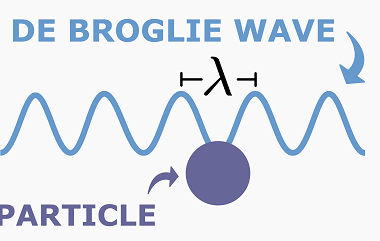
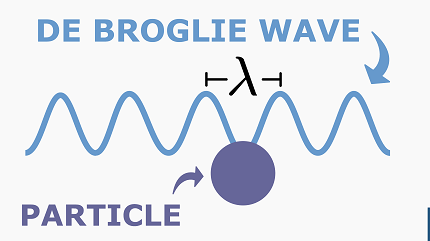
De Broglie wavelength of matter waves

The de Broglie wavelength is a fundamental concept in quantum mechanics that describes the wave-like nature of matter particles, such as electrons, protons, and atoms. It is named after Louis de Broglie, who proposed that all matter particles have a wave-like nature in addition to their particle-like nature. The de Broglie wavelength (λ) is given…

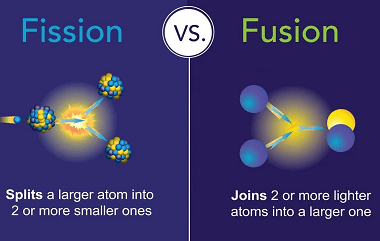
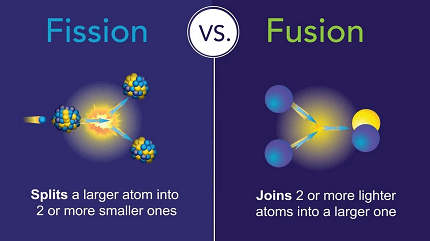
Fission and Fusion processes

Fission and fusion are two types of nuclear processes that involve the splitting and merging of atomic nuclei. Fission is a process in which the nucleus of a heavy atom, such as uranium or plutonium, is split into two smaller nuclei. This process releases a large amount of energy in the form of heat and…

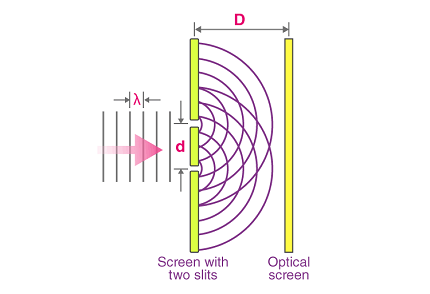
Interference limited to Young’s double slit experiment

In Young’s double-slit experiment, interference occurs due to the wave nature of light. When a beam of light is shone onto two closely spaced slits, the light passing through each slit diffracts and spreads out as if each slit was a new source of light. These two sets of waves then overlap and interfere with…

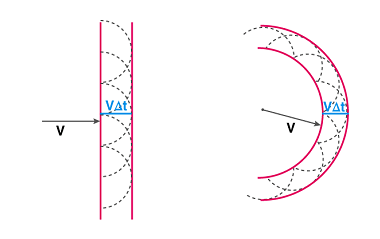
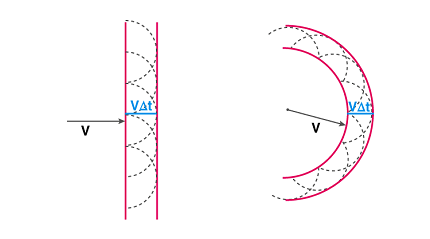
Huygen’s principle

Huygen’s principle, named after the Dutch physicist Christiaan Huygens, is a fundamental principle in wave optics that explains how waves propagate through a medium. According to Huygen’s principle, each point on a wavefront can be considered as a source of secondary spherical waves. These secondary waves travel outwards from each point in all directions at…