Vrindawan Coaching Center

Parallel plate capacitor with

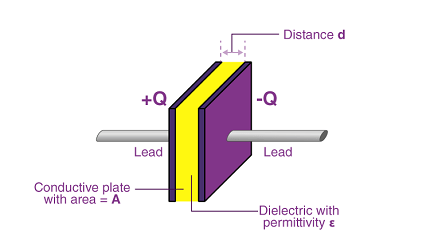
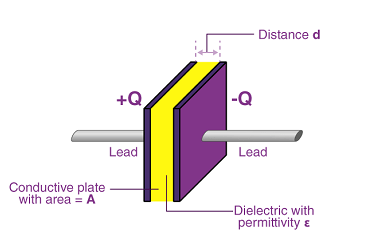
The simplest model of a capacitor consists of two thin parallel conductive plates each with an area of  separated by a uniform gap of thickness  filled with a dielectric with permittivity . It is assumed the gap  is much smaller than the dimensions of the plates. This model applies well to many practical capacitors which are constructed of metal sheets…

Capacitance

Capacitance is a measure of a capacitor’s ability to store electric charge. A capacitor is an electronic component that consists of two conductive plates separated by a dielectric material, such as air or a non-conductive plastic. When a voltage is applied across the plates, electrons from one plate accumulate on the other, creating an electric…

Uniformly charged thin spherical shell

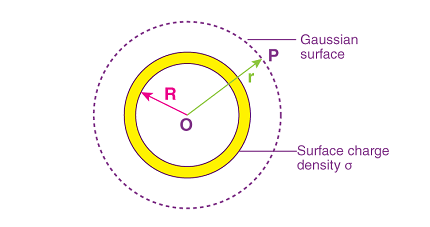
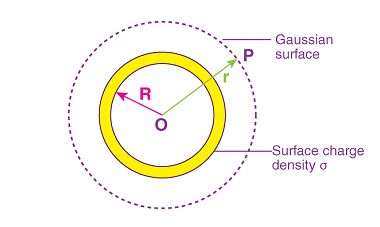
A uniformly charged thin spherical shell refers to a hollow spherical shell with a uniform charge density. The charge density is the amount of charge per unit volume of the shell. This type of system is often studied in electrostatics and can be analyzed using Gauss’s law, which relates the electric flux through a closed…

Uniformly charged infinite plane sheet

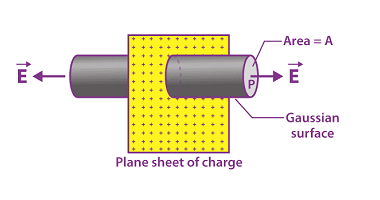
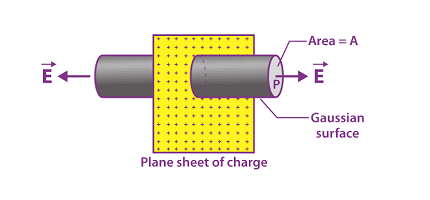
An infinite plane sheet with a uniform charge density is a theoretical construct used in electrostatics to study the behavior of charges in electric fields. When a plane sheet has a uniform charge density, it means that the amount of charge per unit area is constant across the entire sheet. This allows for a simplified…

To find field due to infinitely long straight wire

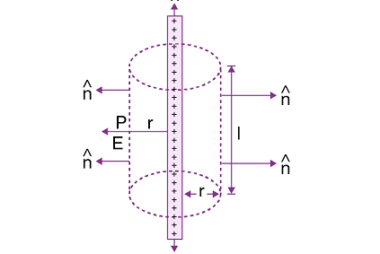
The magnetic field due to an infinitely long straight wire can be calculated using Ampere’s law, which states that the magnetic field around a closed loop is proportional to the current passing through the loop. The formula for the magnetic field due to an infinitely long straight wire is: B = (μ0I)/(2π*r) where B is…

Such as

Electricity and magnetism are two closely related phenomena that are fundamental to our understanding of the physical world. They are both aspects of the electromagnetic force, which is one of the four fundamental forces of nature. Electricity refers to the flow of electric charge, usually in the form of electrons. It is a fundamental force…

Its application in simple cases

Here are some examples of applications in simple cases: These are just a few examples of the many applications that can be considered “simple” in their functionality. What is Required Its application in simple cases To develop an application for simple cases, you would need to have a basic understanding of programming languages such as…

Gauss’s law

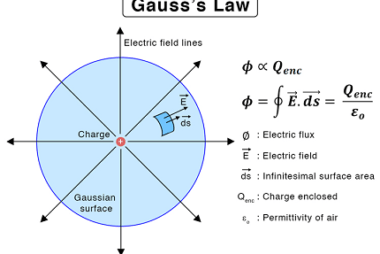
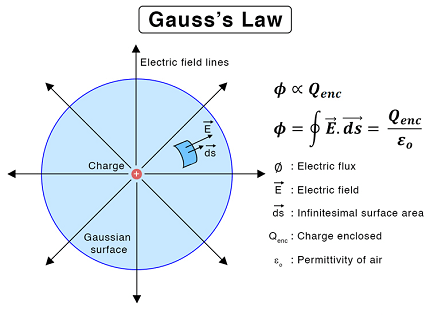
Gauss’s law is a fundamental law of electromagnetism that relates the distribution of electric charge to the resulting electric field. The law states that the electric flux through any closed surface is proportional to the total amount of electric charge enclosed within the surface. In mathematical terms, Gauss’s law can be expressed as: ∮S E…

Flux of electric field

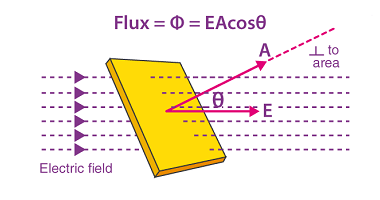
The flux of an electric field is the measure of the number of electric field lines passing through a given surface. It is defined as the electric field strength multiplied by the area of the surface, multiplied by the cosine of the angle between the electric field and the normal to the surface. The mathematical…

Electric field lines

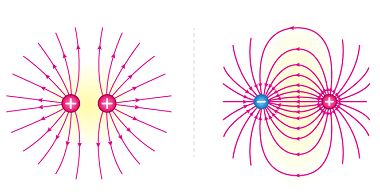
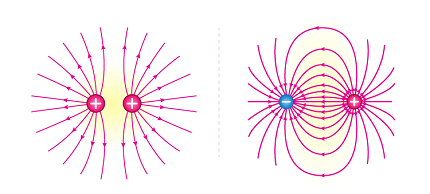
Electric field lines are a visual representation of the electric field around a charged object. Electric field lines are used to show the direction and strength of the electric field. The electric field is a vector field, meaning it has both a magnitude and direction at every point in space. The electric field lines show…